
Behavioral and forensic sciences
Understanding People and Evidence: Foundations of Archaeological, Anthropological, and Forensic Behavioral Sciences
Browse iSKOLAR+
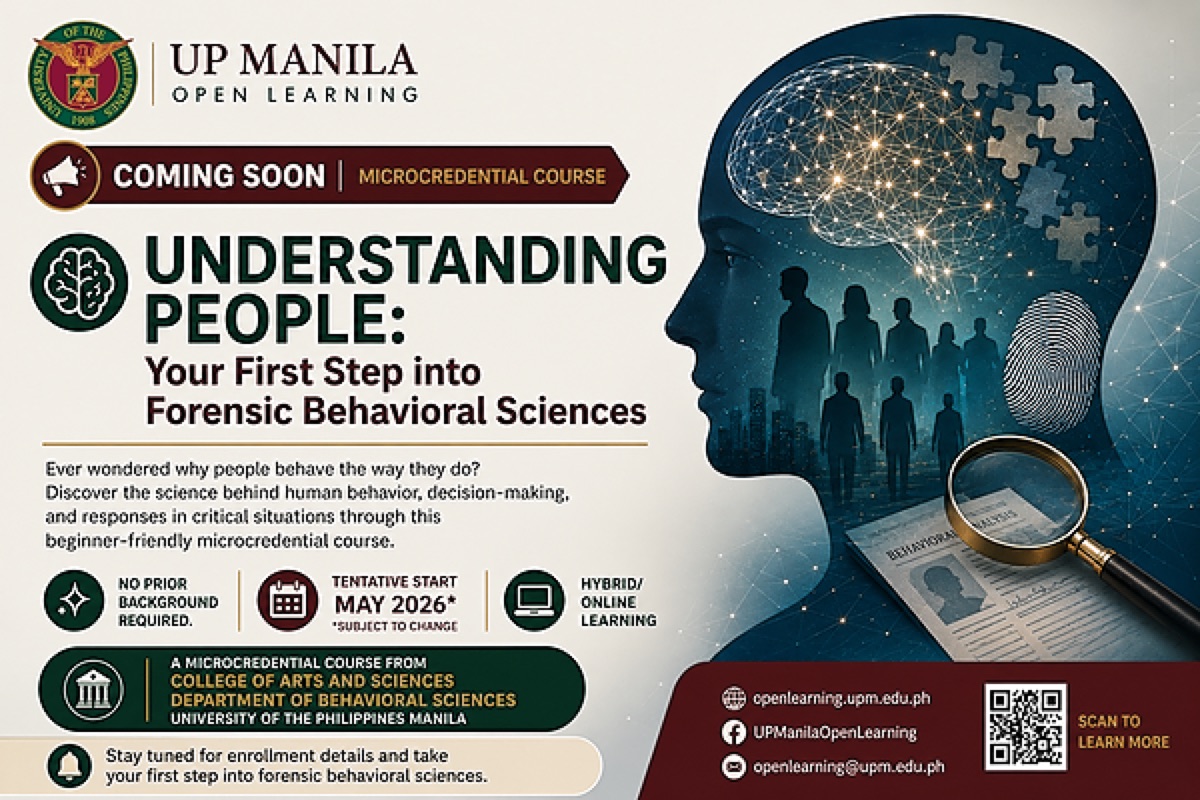
“To understand people is to read evidence—of the mind, of culture, and of the traces they leave behind.” Your first step into forensic behavioral sciences.
Enrollment and lessons are on OpenLearning, UP Manila’s learning platform.
- Enrollment
- Pre-enrollment open
- Course type
- Microcredential
- Offered by
- College of Arts and Sciences, Department of Behavioral Sciences
- Start date
- 15 July 2026
- Duration
- 20–30 hours (hybrid or online)
- Fee
- ₱1,499
- Credit hours
- 30 credit hours
- Credential
- Certificate of completion; badge of completion
- Learners
- 99
About this course
An interdisciplinary microcredential that introduces learners to the scientific and cultural study of human behavior as both experience and evidence. Human actions—whether expressed through thoughts, social interactions, cultural practices, or material remains—leave observable traces, examined here through the combined lenses of psychology, anthropology, archaeology, sociology and forensic science.
The course begins with the psychological foundations of behavior, then situates behavior within cultural and social systems, including Indigenous Knowledge Systems and Practices (IKSP). Learners are introduced to archaeological thinking, where objects, spaces, and landscapes are analyzed as material evidence, and then develop forensic reasoning skills—with particular emphasis on crisis, disaster, and trauma settings, humanitarian response, community resilience, and Disaster Victim Identification (DVI).
The course culminates in a strong emphasis on ethics, human dignity, and cultural sensitivity. Designed as a foundational pathway course, it supports progression into advanced study in forensic behavioral sciences and is particularly responsive to the Global South context. No prior background is required.
What you will learn
At the end of the course, learners are expected to:
- Explain human behavior using fundamental concepts from psychology and behavioral sciences, including cognition, emotion, and decision-making processes.
- Analyze how culture, society, and Indigenous Knowledge Systems and Practices (IKSP) influence human actions and interactions.
- Interpret material culture, objects, and environments as evidence of human behavior using basic archaeological principles.
- Apply introductory forensic thinking to examine behavioral and physical evidence in simulated or real-world scenarios.
- Assess behavioral responses in crisis, disaster, and trauma contexts, integrating psychological and socio-cultural perspectives.
- Demonstrate ethical awareness, cultural sensitivity, and respect for human dignity in the study and interpretation of human behavior.
Teacher
Ma. Teresa De Guzman
Enroll
Enrollment for this course is on OpenLearning. Selecting the button opens the course there, where you sign up or log in, then enroll. See all the steps.
Fees, schedules and enrollment status as of 30 September 2026.